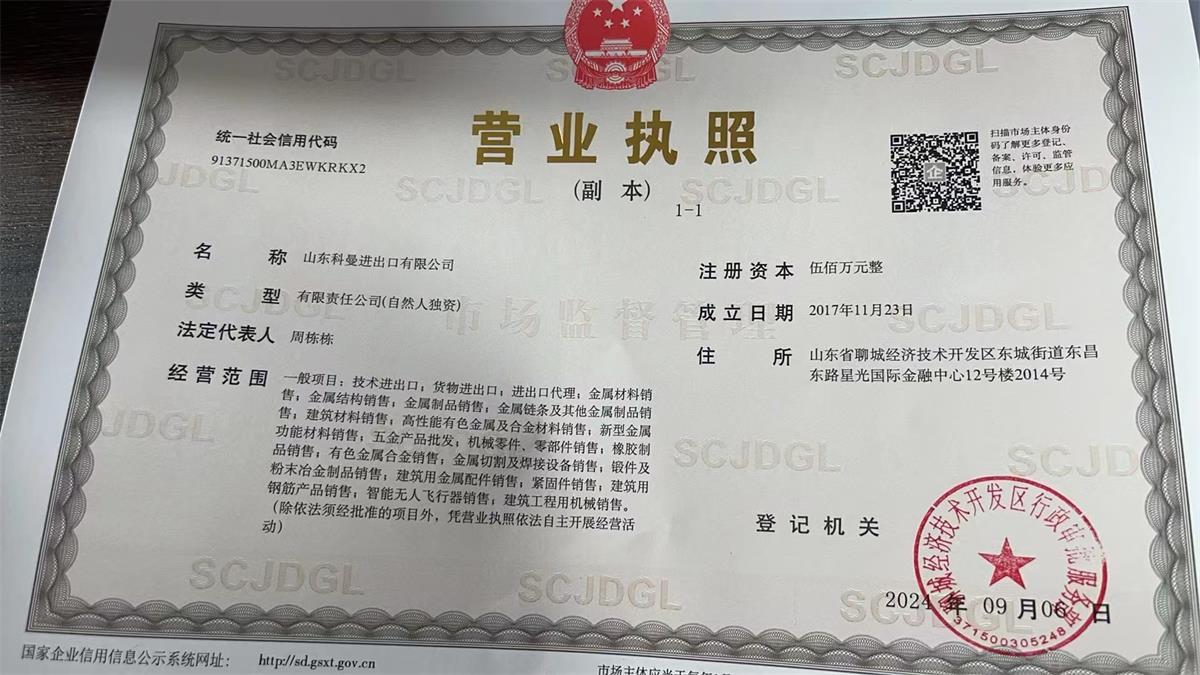
Address:Shandong Keman Import and Export Co., Ltd.

A283 Low Carbon Steel Coil
Release time:
2025-05-23
Thickness | 0.1-16mm | 0.003"-0.62" inch |
Width | 100-3500mm | 3.93"-137" inch |
Coil ID | 508/610mm | 20"/24" inch |
Surface | Oiled, Black Painted, Shot Blasted, Hot Dipped Galvanized, Checkered, etc. | |
Process | Cutting, Bending, Polishing, etc. | |
Advantages | It is easy to form, machine, and weld. It is a high value general use structural steel. | |
Application | ASTM A283 steel coil is used in riveted, bolted, and welded construction of bridges and buildings, and for buildings, including pre-fabricated buildings, warehouses, and industrial and commercial structures. | |
*Here are normal size and standard, special requirements please contact us | ||
Material | ASTM | European/EN | Germany/DlN | France/NFA | Italy/UNI |
1.0035 | A283 | S185 | ST33 | A 33 | Fe 320 |
A283 Low Carbon Steel Coil: An Ideal Steel Product
1. Introduction
A283 low - carbon steel coil is a widely - used steel product in the industrial field. It has a set of excellent properties that make it suitable for a variety of applications.
2. Chemical Composition
Carbon ©: The carbon content in A283 low - carbon steel coil is relatively low, typically ranging from 0.14% to 0.20%. This low carbon level endows the steel with good toughness and weldability.
Manganese (Mn): Manganese is an important alloying element in this steel, with a content of about 0.90 - 1.40%. Mn helps to enhance the strength and hardness of the steel and also has a positive impact on improving its toughness.
Phosphorus (P) and Sulfur (S): The contents of phosphorus and sulfur are strictly controlled. The phosphorus content is no more than 0.035%, and the sulfur content is no more than 0.040%. Low levels of these elements prevent the steel from brittle fracture during processing and use.
3. Mechanical Properties
Strength:
The yield strength of A283 low - carbon steel coil usually lies between 205 MPa and 235 MPa, while the tensile strength ranges from 380 MPa to 440 MPa. These strength characteristics enable it to be used in the manufacturing of structural components that bear certain pressure and tensile forces.
Toughness:
Due to its low - carbon content and appropriate alloy element ratio, A283 low - carbon steel coil has good toughness. It can effectively absorb energy when subjected to impact or dynamic loads without sudden fracture, which is particularly important in construction and mechanical manufacturing fields.
Ductility:
This steel has relatively good ductility, with an elongation percentage of about 23 - 25% (depending on different standards and test conditions). Good ductility allows the steel to be formed into various - shaped parts through rolling, bending, and stamping processes.
4. Machining Properties
Rolling Performance:
A283 low - carbon steel coil performs excellently during the rolling process. It can be smoothly hot - rolled or cold - rolled on the rolling mill. By adjusting the rolling process parameters, steel plates or strips with different thicknesses and precision requirements can be obtained.
Cutting Performance:
Whether it is flame cutting, plasma cutting or mechanical cutting, A283 low - carbon steel coil can be effectively cut. The cutting edges are relatively neat, and there are no serious deformation or crack problems.
Welding Performance:
Its low carbon content gives A283 low - carbon steel coil excellent welding performance. It can be welded by various methods such as arc welding and gas - shielded welding, and the strength and toughness of the welded joints can meet the requirements of most engineering applications.
5. Application Areas
Construction Industry:
In building structures, A283 low - carbon steel coil can be used to manufacture load - bearing components such as steel beams and columns. Its strength and toughness can ensure the safety of buildings under self - weight, wind load, and earthquake load.
Mechanical Manufacturing:
As a raw material for mechanical parts, A283 low - carbon steel coil can be used to manufacture various shells, brackets, and bases. After being processed into the required shapes, it can provide stable structural support for mechanical equipment.
Automotive Manufacturing:
In the automotive industry, A283 low - carbon steel coil can be used to manufacture body frames, doors and other components. Its good machining performance and mechanical properties contribute to the realization of lightweight and high - strength requirements for automotive parts.
Agricultural Equipment Manufacturing:
For agricultural machinery such as tractors and harvesters, A283 low - carbon steel coil can be used to manufacture frames, shells and other components, adapting to various stress and load requirements in the agricultural production environment.
6. Surface Treatment
Rust Prevention Treatment:
To prevent A283 low - carbon steel coil from rusting during storage and use, anti - rust treatment methods such as painting and galvanizing can be adopted. Painting can provide good protection and decorative effects, while galvanizing can protect the steel from corrosion by forming a zinc layer.
Surface Finish Treatment:
According to different application requirements, the surface of A283 low - carbon steel coil can be ground, polished and other treatments to obtain the required surface finish. For example, in some equipment manufacturing with high appearance requirements, the polished steel surface can improve the overall aesthetics of the product.
In conclusion, A283 low - carbon steel coil, with its excellent comprehensive properties, plays an important role in multiple industrial fields, and its application range is expected to be further expanded with the continuous development of technology.
Latest News
Innovative Applications of Carbon Steel Plates in Building Designs
Innovative Applications of Carbon Steel Plates in Building Designs Carbon steel plates have emerged as a cornerstone material in the construction industry, gaining acclaim for their versatility, strength, and aesthetic potential. As the demand for innovative design solutions escalates, architects and builders are increasingly incorporating carbon steel plates into their projects. This article expl
2026-09-22
Understanding A514 Carbon Steel Plate: Key Characteristics and Applications
A514 Carbon Steel Plate is a high-yield strength steel that has become a preferred choice in various industrial applications, particularly in the fields of metallurgy and energy. This type of steel is known for its excellent mechanical properties, making it suitable for demanding environments where strength and durability are paramount. One of the key characteristics of A514 Carbon Steel Plate is
2026-09-17
How A387 Carbon Alloy Steel Plate Enhances Structural Integrity in Construction
How A387 Carbon Alloy Steel Plate Enhances Structural Integrity in Construction Table of Contents 1. Introduction to A387 Carbon Alloy Steel Plate 2. What is A387 Carbon Alloy Steel? 3. Key Properties of A387 Carbon Alloy Steel Plates 4. Manufacturing Process of A387 Steel Plates 5. Applications of A387 Carbon Alloy Steel Plates 6. Advantages of Using A387 Carbon Alloy Ste
2026-09-12
Understanding A285 Carbon Steel Pressure Plates: Essential Insights for Construction and Design
A285 Carbon Steel Pressure Plates are primarily used in pressure vessel fabrication and construction applications. This type of steel is known for its good weldability and formability, making it a favorable choice for various structural components. The ASTM A285 standard specifically governs the specifications for carbon steel plates intended for low-pressure service. One of the key characteristic
2026-09-07
The Role of 5A05 Aluminum Plate in Enhancing Building Aesthetics
The Role of 5A05 Aluminum Plate in Enhancing Building Aesthetics Table of Contents 1. Introduction to 5A05 Aluminum Plates 2. Properties of 5A05 Aluminum Plates 3. Applications of 5A05 Aluminum Plates in Architecture 4. Aesthetic Advantages of Using 5A05 Aluminum Plates 5. Sustainability and Environmental Impact 6. Installation and Maintenance of 5A05 Aluminum Plates 7
2026-09-02
Understanding B500 Steel Reinforcement: Key Insights for Professionals in Construction Machinery
B500 steel reinforcement is a critical component in the construction industry, particularly in manufacturing and processing machinery for engineering and construction projects. This high-strength steel bar is widely used in reinforced concrete structures, providing the necessary tensile strength to support heavy loads and withstand various stresses. One of the defining characteristics of B500 stee
2026-08-28


Copyright 2025 : Shandong Keman Import and Export Co., Ltd. Powered by:CEglobal SEO BUSINESS LICENSE