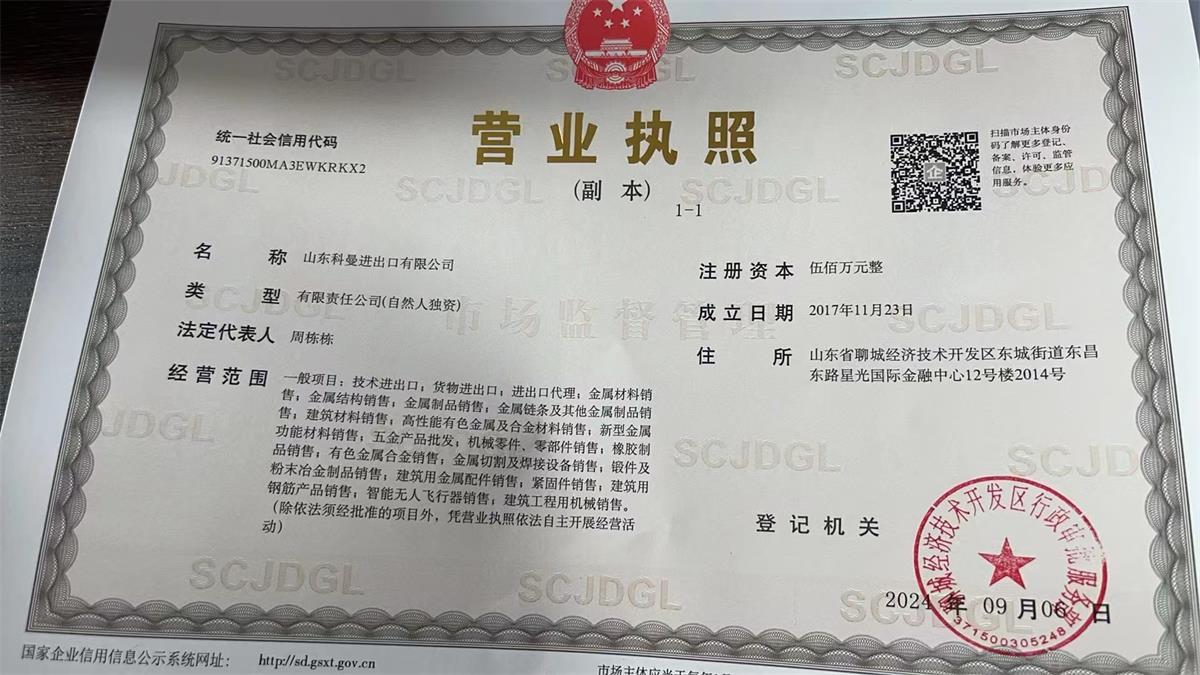
Address:Shandong Keman Import and Export Co., Ltd.

Why Choose B500 Steel Reinforcement for Your Next Construction Project?
Release time:
2025-06-14
Why Choose B500 Steel Reinforcement for Your Next Project? Table of Contents What is B500 Steel Reinforcement? Properties of B500 Steel Reinforcement Advantages of Using B500 Steel Reinforcement Applications of B500 Steel Reinforcement B500 Steel vs Other Steel Grades The Sustainability Aspect of B500 Steel Reinforcement Installation and Handling of B500 Steel Reinforc
Why Choose B500 Steel Reinforcement for Your Next Project?
Table of Contents
- What is B500 Steel Reinforcement?
- Properties of B500 Steel Reinforcement
- Advantages of Using B500 Steel Reinforcement
- Applications of B500 Steel Reinforcement
- B500 Steel vs Other Steel Grades
- The Sustainability Aspect of B500 Steel Reinforcement
- Installation and Handling of B500 Steel Reinforcement
- Cost-Effectiveness of B500 Steel Reinforcement
- Frequently Asked Questions
What is B500 Steel Reinforcement?
B500 steel reinforcement is a high-strength steel bar designed for various construction applications. It is classified under the Eurocode standard for reinforced concrete structures, characterized by its yield strength of 500 MPa. This steel grade is primarily used to enhance the tensile strength of concrete, ensuring that structures can withstand various loads and stresses effectively.
B500 bars are made from high-quality raw materials, which undergo advanced manufacturing processes, resulting in a product that offers superior performance in construction projects. The bars have a ribbed surface, which allows for better bonding with concrete, contributing to the overall strength of the structure.
Properties of B500 Steel Reinforcement
B500 steel reinforcement boasts several key properties that make it a preferred choice in the construction industry:
Tensile Strength
With a yield strength of 500 MPa, B500 steel exhibits remarkable tensile strength, ensuring that it can effectively bear heavy loads without deforming.
Corrosion Resistance
B500 steel is designed to be resistant to corrosion, making it suitable for environments where exposure to moisture and chemicals is a concern.
Durability
The high-quality manufacturing process enhances the durability of B500 steel reinforcement, allowing it to maintain its structural integrity over time, even in harsh conditions.
Workability
B500 steel is easy to cut, bend, and shape, making it a convenient option for construction teams during installation.
Advantages of Using B500 Steel Reinforcement
Choosing B500 steel reinforcement for your next construction project offers numerous advantages:
Enhanced Structural Integrity
The high tensile strength of B500 steel ensures that structures can handle significant loads and stresses, contributing to their overall safety and longevity.
Cost-Effectiveness
While the initial cost of B500 steel may be higher than lower-grade options, its durability and performance characteristics lead to reduced maintenance costs and extended lifespan, ultimately proving to be more cost-effective in the long run.
Versatility
B500 steel reinforcement is suitable for a wide range of applications, including residential buildings, bridges, highways, and industrial structures, making it a versatile choice for various construction needs.
Improved Construction Speed
The workability of B500 steel allows for quick and efficient installation, reducing project timelines and labor costs.
Applications of B500 Steel Reinforcement
B500 steel reinforcement is utilized in various construction projects, including:
Residential Construction
In residential buildings, B500 steel is used in foundations, walls, and slabs, providing the necessary support to withstand loads and stresses.
Commercial and Industrial Structures
For commercial buildings and industrial facilities, B500 steel reinforcement is critical in ensuring structural integrity, especially in high-load areas such as warehouses and manufacturing plants.
Infrastructure Projects
B500 steel is commonly used in the construction of bridges, highways, and tunnels, where durability and high strength are essential for safety and longevity.
B500 Steel vs Other Steel Grades
When comparing B500 steel reinforcement to other steel grades, it is essential to consider the key differences:
B500 vs B400
While both B500 and B400 steel reinforcement bars serve similar purposes, B500 offers a higher yield strength, making it a more robust choice for demanding construction projects.
B500 vs B600
B600 steel reinforcement bars are stronger than B500 options, but they may be over-engineered for some projects. B500 provides a balance between strength and cost, making it a practical choice for many applications.
B500 vs Plain Steel Bars
Plain steel bars lack the ribbed surface of B500, resulting in poorer bonding with concrete. The adoption of B500 bars leads to better structural performance.
The Sustainability Aspect of B500 Steel Reinforcement
Sustainability is becoming increasingly important in construction, and B500 steel reinforcement contributes positively in several ways:
Recyclability
B500 steel can be recycled without loss of quality, making it an environmentally friendly option for construction projects.
Longevity
The durability of B500 steel means structures require less frequent replacement or repair, reducing the overall environmental impact over time.
Reduced Material Usage
Utilizing high-strength B500 steel allows for the use of lesser quantities while maintaining structural integrity, leading to less consumption of resources.
Installation and Handling of B500 Steel Reinforcement
Proper installation and handling of B500 steel reinforcement are crucial for maximizing its performance:
Site Preparation
Ensure the construction site is adequately prepared, including clean surfaces and appropriate rebar spacing as per engineering specifications.
Cutting and Bending
Using proper tools, B500 steel can be easily cut and bent according to project requirements. It is essential to follow safety guidelines during this process.
Placement
Careful placement of B500 bars in concrete forms is critical to achieving optimal strength and performance. Follow design specifications for spacing and layering.
Cost-Effectiveness of B500 Steel Reinforcement
The initial investment in B500 steel reinforcement may be higher, but its cost-effectiveness becomes apparent through:
Lower Maintenance Costs
The durability and corrosion resistance of B500 steel lead to fewer repairs and maintenance needs over the structure's lifespan.
Longer Lifespan
Choosing B500 steel reinforcement contributes to a longer lifespan for structures, which translates into cost savings over time.
Increased Property Value
Structures built using high-quality materials like B500 steel reinforcement often have higher property values, making them a worthy investment.
Frequently Asked Questions
1. What is the difference between B500 and B400 steel reinforcement?
B500 steel has a higher yield strength of 500 MPa compared to B400's 400 MPa, making B500 more suitable for high-load applications.
2. Is B500 steel reinforcement available in different sizes?
Yes, B500 steel reinforcement bars come in various diameters, catering to different construction needs.
3. How does B500 steel fare in corrosive environments?
B500 steel is designed to resist corrosion, making it ideal for projects exposed to moisture and chemicals.
4. Can B500 steel reinforcement be recycled?
Absolutely! B500 steel is fully recyclable without compromising its quality, making it an eco-friendly choice.
5. What types of projects is B500 steel reinforcement best suited for?
B500 steel is versatile and used in residential, commercial, industrial, and infrastructure projects, ensuring structural integrity and safety.
Conclusion
In summary, B500 steel reinforcement stands out as a superior choice for construction projects due to its impressive properties, advantages, and applications. Its high tensile strength, durability, and resistance to corrosion make it an ideal material for ensuring structural integrity in various environments. While the initial costs may be higher, the long-term benefits, including reduced maintenance and increased property value, make it a cost-effective option. By choosing B500 steel reinforcement, you are not only investing in quality but also contributing to sustainable construction practices. For your next project, consider the unmatched reliability and performance that B500 steel reinforcement has to offer.
Latest News
Innovative Applications of Carbon Steel Plates in Building Designs
Innovative Applications of Carbon Steel Plates in Building Designs Carbon steel plates have emerged as a cornerstone material in the construction industry, gaining acclaim for their versatility, strength, and aesthetic potential. As the demand for innovative design solutions escalates, architects and builders are increasingly incorporating carbon steel plates into their projects. This article expl
2026-09-22
Understanding A514 Carbon Steel Plate: Key Characteristics and Applications
A514 Carbon Steel Plate is a high-yield strength steel that has become a preferred choice in various industrial applications, particularly in the fields of metallurgy and energy. This type of steel is known for its excellent mechanical properties, making it suitable for demanding environments where strength and durability are paramount. One of the key characteristics of A514 Carbon Steel Plate is
2026-09-17
How A387 Carbon Alloy Steel Plate Enhances Structural Integrity in Construction
How A387 Carbon Alloy Steel Plate Enhances Structural Integrity in Construction Table of Contents 1. Introduction to A387 Carbon Alloy Steel Plate 2. What is A387 Carbon Alloy Steel? 3. Key Properties of A387 Carbon Alloy Steel Plates 4. Manufacturing Process of A387 Steel Plates 5. Applications of A387 Carbon Alloy Steel Plates 6. Advantages of Using A387 Carbon Alloy Ste
2026-09-12
Understanding A285 Carbon Steel Pressure Plates: Essential Insights for Construction and Design
A285 Carbon Steel Pressure Plates are primarily used in pressure vessel fabrication and construction applications. This type of steel is known for its good weldability and formability, making it a favorable choice for various structural components. The ASTM A285 standard specifically governs the specifications for carbon steel plates intended for low-pressure service. One of the key characteristic
2026-09-07
The Role of 5A05 Aluminum Plate in Enhancing Building Aesthetics
The Role of 5A05 Aluminum Plate in Enhancing Building Aesthetics Table of Contents 1. Introduction to 5A05 Aluminum Plates 2. Properties of 5A05 Aluminum Plates 3. Applications of 5A05 Aluminum Plates in Architecture 4. Aesthetic Advantages of Using 5A05 Aluminum Plates 5. Sustainability and Environmental Impact 6. Installation and Maintenance of 5A05 Aluminum Plates 7
2026-09-02
Understanding B500 Steel Reinforcement: Key Insights for Professionals in Construction Machinery
B500 steel reinforcement is a critical component in the construction industry, particularly in manufacturing and processing machinery for engineering and construction projects. This high-strength steel bar is widely used in reinforced concrete structures, providing the necessary tensile strength to support heavy loads and withstand various stresses. One of the defining characteristics of B500 stee
2026-08-28


Copyright 2025 : Shandong Keman Import and Export Co., Ltd. Powered by:CEglobal SEO BUSINESS LICENSE