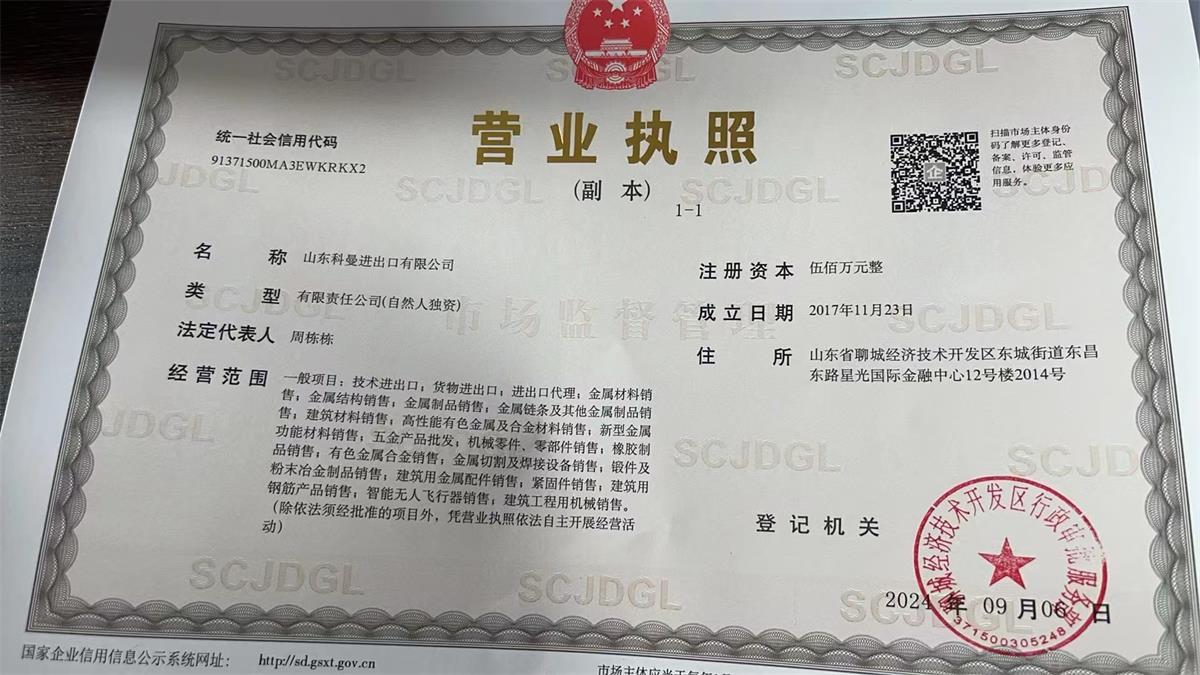
Address:Shandong Keman Import and Export Co., Ltd.
PRODUCTS
A709 Carbon Structural Steel Plate

The ASTM A709 is the Standard Specification for Structural Steel for Bridges and encompasses carbon, high-strength low-alloy, and quenched and tempered alloy steels used as structural plates in the construction of bridges. It following five grades of A709; 36, 50, 50W, HPS 50W and HPS 70W.
A588 Low Alloy Structural Steel Plate
ASTM A588 is a high strength low-alloy structural steel specification with higher strength and improved atmospheric corrosion resistance. It covers Grade A, Grade B, and Grade K. Grade A, B is the specification for atmospheric corrosion structural steel of High-Strength Low-Alloy, yield strength minimum 50 ksi 345 Mpa.
ASTM A516 covers carbon steel plates intended primarily for service in welded pressure vessels where improved notch toughness is important. According to different strength levels, the plates are available in four grades: Grades 55, 60, 65, and 70. The most common is Grade 70 or called out A516-70.
ASTM A537 standard refers to pressure vessel plates, material in heat-treated, carbon-manganese silicon steel. Based on different strength and heat treatment, it ranges to Class 1, 2 and 3. ASTM A537 Class 1 plates are supplied in the normalised condition whilst Class 2 plates are quenched and tempered.
ASTM A514 steel (also known as T1) grades incloud A, B, E, F, H, P, Q & S. This steel plate has a high yield strength and good weldability. ASTM A514 steel plate is quenched and tempered carbon-alloy steel. It is typically used when abrasion resistance and high-impact properties are required.


Copyright 2025 : Shandong Keman Import and Export Co., Ltd. Powered by:CEglobal SEO BUSINESS LICENSE