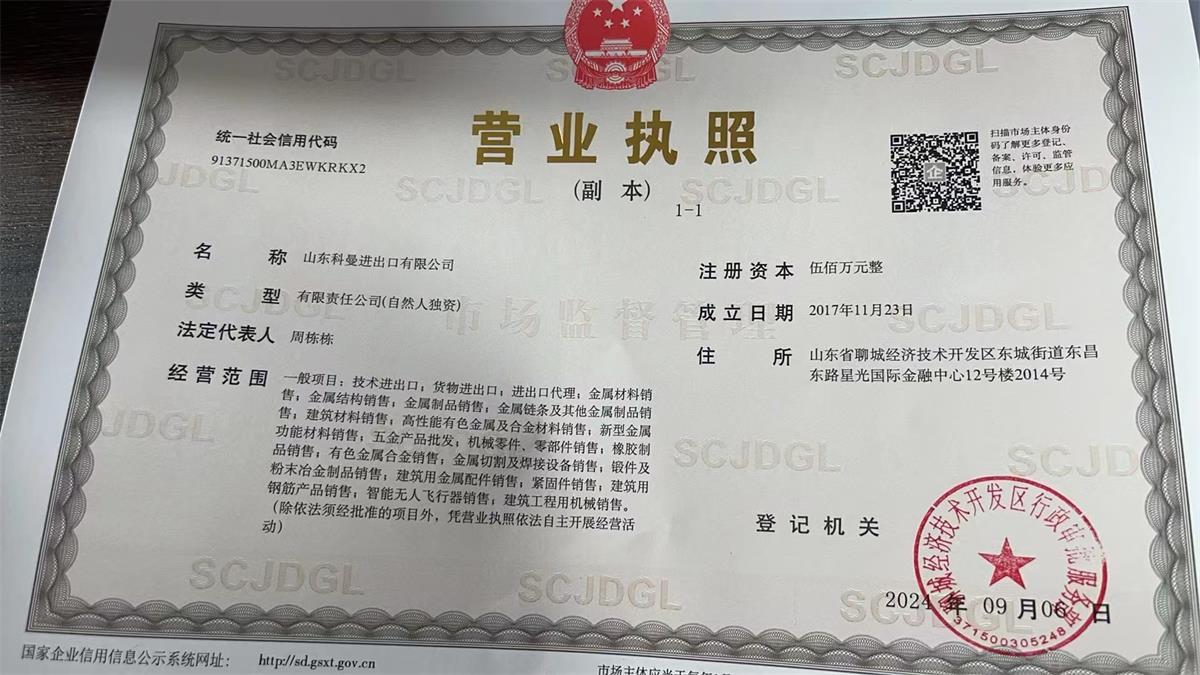
Address:Shandong Keman Import and Export Co., Ltd.
PRODUCTS

ASTM A537 standard refers to pressure vessel plates, material in heat-treated, carbon-manganese silicon steel. Based on different strength and heat treatment, it ranges to Class 1, 2 and 3. ASTM A537 Class 1 plates are supplied in the normalised condition whilst Class 2 plates are quenched and tempered.
ASTM A514 steel (also known as T1) grades incloud A, B, E, F, H, P, Q & S. This steel plate has a high yield strength and good weldability. ASTM A514 steel plate is quenched and tempered carbon-alloy steel. It is typically used when abrasion resistance and high-impact properties are required.
Tin Mill Black Plate (TMBP) steel is manufactured from hot rolled coils by pickling to remove the surface oxide produced during the hot rolling stage, and cold reducing through a cold mill to the desired thickness. TMBP produces a low ductility product that is usually processed further to develop desired end use characteristics.
Differential Thickness Tinplate
Differential thickness tinplate is a cold-rolled electroplated tin plate with different tin plating amounts on both sides. Tin plated sheet is made by rolling low carbon steel, followed by acid washing, cold rolling, electrolytic cleaning annealing, leveling, edge cutting processing, and then cleaning, electroplating, softening, passivation treatment, and oil coating before cutting into finished tin plated sheet metal.


Copyright 2025 : Shandong Keman Import and Export Co., Ltd. Powered by:CEglobal SEO BUSINESS LICENSE